The First 24 Hours After Upload: What Matters, and What Is Folklore
Launch day generates more ritual than any other part of creating on YouTube. Some of it is grounded in how distribution actually works. A surprising amount of it is inherited advice that made sense on a different platform, in a different decade, or never at all — and it consumes hours that would be better spent on the next video.
Method and evidence: This article offers a launch workflow. Scheduling suggestions and observation windows are editorial choices, not universal thresholds published by YouTube.
This is a sorting exercise. Each practice below gets a verdict, a mechanism where one exists, and a note on what to do instead where it does not.
- Early performance matters because it is the first evidence, not because of a magic window.
- Anything that drives clicks from people who will not stay makes things worse, not better.
- The high-yield launch-day work is almost all preparation done before publishing.
- Judging a video at 24 hours mostly measures how active your subscribers are.
The mechanism, briefly
A new video is shown first to a limited group of likely matches — largely your existing audience — and the system watches what they do with it. Strong response widens distribution; weak response narrows it. There is no timer attached to this. It is simply that the first evidence available is the earliest evidence, so early signals disproportionately shape what happens next.
A relevant announcement can help interested viewers find a new video. A poorly matched audience may respond differently, but that does not by itself prove an algorithmic penalty. Treat external promotion as an audience decision and record its traffic separately where the reports allow it.
The verdicts
| Practice | Verdict | Why |
|---|---|---|
| Publishing at a "best time" | Minor, real | Matters mainly if your audience clusters in one timezone. Cannot rescue a video nobody wants; worth setting once and forgetting. |
| Replying to early comments | Worth doing, wrong reason | It does not feed the algorithm. It builds the returning-viewer habit, which is a far more valuable long-run signal. |
| Sharing to unrelated groups for a "boost" | Harmful | Imports viewers who leave in seconds. Worse than no traffic at all. |
| Pinning a comment with context | Mildly useful | Reduces predictable questions and clarifies scope. Not a ranking device. |
| Editing the title in the first hours | Neutral to useful | No penalty exists for this. Just change one thing at a time so you can read the result. |
| Sub-for-sub, engagement pods | Harmful | Manufactures signals from people with no genuine interest, and inflates a subscriber base that will not return. |
| Premieres | Situational | Good for audiences that show up live. For everyone else, the empty-chat effect and the countdown cost you more than they return. |
| Deleting and re-uploading a flop | Almost always wrong | Discards the video's accumulated history and traffic relationships. Re-package instead. |
| End screens and cards set up before publishing | Genuinely useful | Directly affects whether the session continues, which is a real signal. |
| Watching your own analytics all day | Costly | The numbers are too noisy at this stage to act on, and the time is real. |
The four that actually earn their time
1Get the packaging right before you publish
Nothing you do after upload has the leverage of the thumbnail and title. If you have twenty spare minutes on launch day, they are worth more spent checking the packaging at browsing size than on any post-publish ritual. View the thumbnail at about 210 pixels wide alongside the other cards it will appear next to, and ask whether the title adds information to the image or merely repeats it.
2Check the first thirty seconds one final time
The early retention drop is where the largest single loss occurs on almost every video, and it is driven by whether the opening confirms the promise the packaging made. Watch your first thirty seconds once more, ideally on a phone, as though you had never seen it. Our breakdown of hook anatomy gives the checklist.
3Set up where the viewer goes next
End screens, a pinned comment pointing at the obvious follow-up, a description link to the related video. Whether a session continues after your video is a real signal, and it is one of the few things you can influence directly with ten minutes of work.
4Reply to early comments — as a habit, not a tactic
Early commenters are your most invested viewers. Replying makes them more likely to return, and returning viewership is a durable advantage that compounds across every future upload. Do it because it builds the audience, not because you think it feeds a ranking system.
Viewers can choose their notification settings. A notification count does not by itself describe the quality of a subscriber relationship. Use the reports available in your own account and avoid inferring private recommendation rules from notification behavior.
Why 24 hours is the wrong review window
The first day can reflect a different traffic mix from later periods, including returning viewers, subscribers or external promotion. Check your actual reports rather than assuming that every launch is dominated by subscribers. The useful comparison window depends on the format and question.
Videos serving search intent behave differently again: they can accumulate slowly for weeks or months and end up well ahead of a video that spiked on day one. Judging both by the same 24-hour yardstick will systematically push you toward the wrong kind of content.
A reasonable review cadence:
- Day 1: check nothing except that the video plays, the captions are not nonsense, and the links work.
- Day 7: look at traffic sources and the retention curve. This is where the diagnosis lives.
- Day 30: compare against your last five to ten videos. This is the number that means something.
A pre-publish checklist
Almost all launch-day value is captured before the button is pressed. This is the version worth keeping:
- Thumbnail checked at browsing size, next to competing cards.
- Title front-loads the essential part and survives truncation at roughly sixty characters.
- Title and thumbnail say different things that point at the same promise.
- First thirty seconds confirm that promise visibly.
- End screen points to a specific relevant video, not a generic playlist.
- Description has the context and links a viewer would actually want in the first two lines.
- Chapters set, if the video has natural sections.
- Captions checked for the words that matter — auto-captions mangle jargon and names.
- A pinned comment drafted, if there is a predictable question.
That list takes about fifteen minutes and outperforms an entire day of refreshing the analytics page.
Frequently asked questions
Sources and scope
- YouTube: performance and discovery FAQ — publishing time, viewer response and long-term performance.
The linked documentation supports platform definitions and features. The article’s practical framework is YTGrid’s editorial reasoning. For a record you can inspect, use the research worksheet and worked example.
YouTube Recommendations: What Is Documented and What You Can Test
A source-based explanation of YouTube discovery, the limits of public analytics and a practical workflow for investigating a performance change.
Growth & AlgorithmCompare CTR and Retention Without Mixing Audiences
A practical way to investigate packaging and viewing behavior without treating aggregate metrics as proof of causation.
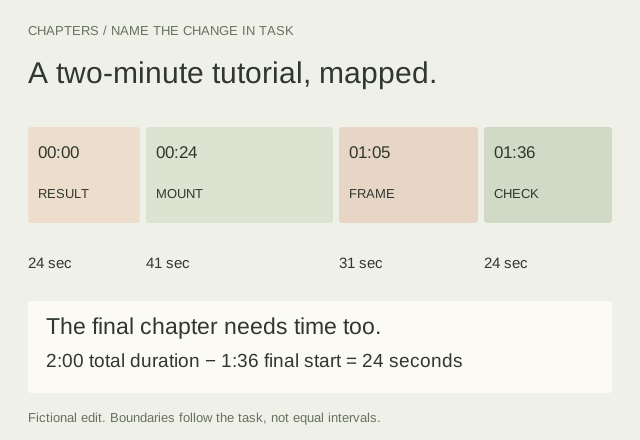
Plan Useful Chapters for a Finished Video
Map a two-minute edit, name the changes in task and check the final chapter as carefully as the first. Includes a blank chapter worksheet.