The Six-Channel Wall: A Weekly Competitive Research Routine
Most creators research their niche by scrolling, occasionally, when they run out of ideas. The result is a patchy sense of what other people are doing, heavily weighted toward whatever the algorithm happened to serve them that week — which is a sample selected to match their own viewing habits, not their audience's.
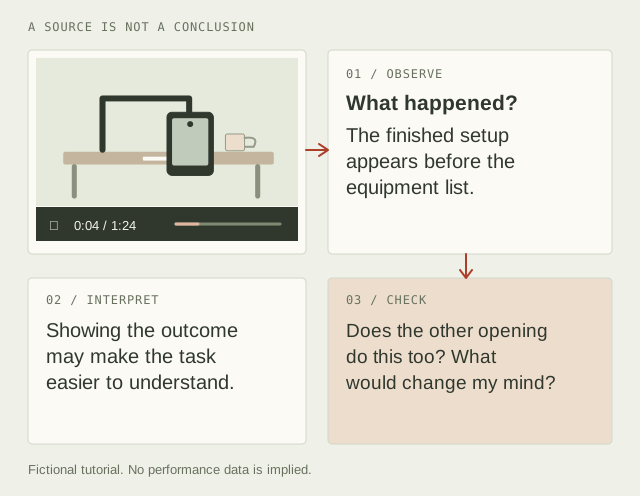
Method and evidence: The rubric and timings here are editorial suggestions for studying a video. They are not a measured retention dataset or a prediction of performance. Public competitor videos do not reveal private CTR or audience-retention reports.
A structured weekly pass fixes that. Ninety minutes, six channels, the same questions every time, written down. The value is not in any single session; it is that after two months you have a record of how your niche actually moves, and patterns become visible that no amount of scrolling would have surfaced.
- Pick six channels deliberately across three tiers — do not just pick the biggest.
- Same questions, same order, every week. Consistency is what makes patterns visible.
- Watch openings and packaging closely; skim the middles.
- The output is one page a week and a monthly review. Anything longer will not survive.
Choosing the six
The instinct is to pick the six biggest channels in your niche. That is the wrong set, because at very different scales the same tactics do different things — a channel with two million subscribers gets clicks on recognition, and copying their minimalist thumbnails will simply make you invisible.
Pick across three tiers instead:
- Two peers — roughly your size, same subject area. These are the most directly informative, because anything that works for them can plausibly work for you.
- Two one tier up — three to ten times your size. Close enough that their tactics still transfer, far enough that they have solved problems you have not reached yet.
- Two rising — smaller than you but growing quickly. These are the most valuable and the most often ignored. A channel growing fast from a small base is doing something new, and it is usually visible in their packaging or format before it shows up anywhere else in the niche.
Review the six every quarter. Channels stall, pivot, or stop uploading, and a stale set quietly stops producing information.
Include one adjacent-niche channel if you can spare the slot. An adjacent subject can suggest approaches you have not tried. Treat transfer to your own audience as a hypothesis, not a forecast about the niche.
Setting up the wall
The mechanical problem with this routine is tab management. Six channels means a great deal of clicking back and forth, and every switch costs you the comparison you were holding in your head — which is the entire point of doing them together rather than separately.
Use one worksheet with a section for each source. Open the videos on their original YouTube pages and watch them in the same order each week. Record the source link, the moment you checked and your observation before moving to the next video. The research notebook method keeps that record separate from your interpretation.
The tool is incidental. What matters is that you can compare six things simultaneously and record what you notice without breaking flow. Six browser windows tiled manually works fine too.
The ninety-minute routine
1The packaging sweep — 15 minutes
Open all six channels' recent uploads. Do not watch anything yet. Look only at the thumbnails and titles as a set, at browsing size.
Ask: what is everyone doing the same way? What is the one channel doing differently? Has anyone changed their style since last week? Which of these would you click if you were a viewer rather than a competitor?
The convergence is the useful part. When five of six channels adopt the same thumbnail style, that style has stopped being a differentiator and become the baseline — which means the opportunity has moved to whoever breaks from it next.
2The opening pass — 25 minutes
Watch the first sixty seconds of each channel's most recent video. Only the first sixty seconds. Six openings back to back is a much sharper comparison than six openings spread across a week, because you can hear the differences directly.
Note for each: what kind of opening is it, how long before the subject is clear, is there a branded intro, and where is the first genuine hook. Our breakdown of hook anatomy gives the components to label.
3The topic scan — 15 minutes
List what all six have covered in the past week or two. You are looking for three things: subjects that multiple channels hit independently (the niche is moving there), subjects one channel has claimed and owns, and obvious gaps nobody is covering.
Gaps require care. Some are gaps because the topic does not work, and you can usually tell which by checking whether anyone tried it and it flopped. Look for videos that underperformed the channel's baseline on that subject — that is a gap with a reason.
4The outlier check — 20 minutes
For each channel, find any video from the last month that clearly beat its neighbours. Watch enough of it to form a hypothesis about why: was it the topic, the packaging, the timing, an unusual format, or something borrowed from elsewhere?
Write the hypothesis down even when you are unsure. Half of them will be wrong, and the value comes from checking them later — a hypothesis you recorded in May and can evaluate in July is worth more than a confident guess you never wrote down.
5The comment sample — 10 minutes
Read fifteen comments on one competitor's recent video. Not yours — theirs. You are listening for what this audience wants that they are not getting: requests, complaints, recurring questions, "can you do X next."
This is the most direct route to a video idea in the entire routine, because it is an audience in your niche telling you explicitly what is missing.
6The write-up — 5 minutes
One page. If it takes longer, the format is too elaborate and you will stop doing it within a month.
The log format
Keep it to five lines a week. The constraint is deliberate — a log you actually maintain beats a thorough one you abandon.
| Field | What goes in it |
|---|---|
| Packaging shift | Anything that changed in how the niche presents itself this week. Often blank — that is fine and itself informative. |
| Topic movement | Subjects gaining or fading. Note who got there first. |
| Outlier + hypothesis | The best-performing video you saw and your guess at why, in one sentence. |
| Audience request | Something the comments asked for that nobody has made. |
| One thing to try | A single testable change. One, not five — you can only run one clean experiment at a time anyway. |
Keep a record you can check
Review each passage on its original page and note the source, timestamp and observation.
Download the research worksheetThe monthly review
Once a month, read the last four weekly logs together. This is where the routine pays off, because individual weeks are noise and four weeks is a trend.
Three questions:
- Which hypotheses held up? Go back to the outliers you noted a month ago. Did the pattern repeat on those channels, or was it a one-off? Patterns that repeat across channels are worth adopting; ones that appeared once were probably topic luck.
- What did you try, and what happened? If you have been logging one thing to try each week and never trying any of them, the routine has become entertainment. Cut back to one experiment a month and actually run it.
- Is the set still right? Has a rising channel stalled? Has a peer pulled ahead? Swap out anything that has stopped producing information.
Once a quarter, go deeper on one channel with a full thumbnail teardown — the weekly wall tells you what is happening, and the teardown tells you why one specific channel's packaging works.
Two failure modes
Turning into a copying machine
The routine surfaces what everyone else is doing, and the naive response is to do it too. But by the time a pattern is visible across six channels, adopting it makes you the seventh — you arrive as the least differentiated version of an idea whose returns are already declining. Use the log to find what is absent as much as what is present.
Research as procrastination
Ninety minutes a week is the budget. It is very easy to turn competitive research into a comfortable substitute for making videos, because it feels productive and involves no risk. If your research time exceeds your production time in any week, the routine has stopped working. Cap it, do it on a fixed day, and stop when the timer goes.
Frequently asked questions
Sources and scope
- YouTube: audience-retention reports — what the report can show for your own videos.
- YouTube: title and thumbnail tests — native testing and the meaning of its results.
The linked documentation supports platform definitions and features. The article’s practical framework is YTGrid’s editorial reasoning. For a record you can inspect, use the research worksheet and worked example.
Turn Video Observations into a Research Notebook
Keep timestamped evidence separate from interpretation, check AI-assisted notes and export a notebook. Includes a fictional worked example and a blank worksheet.
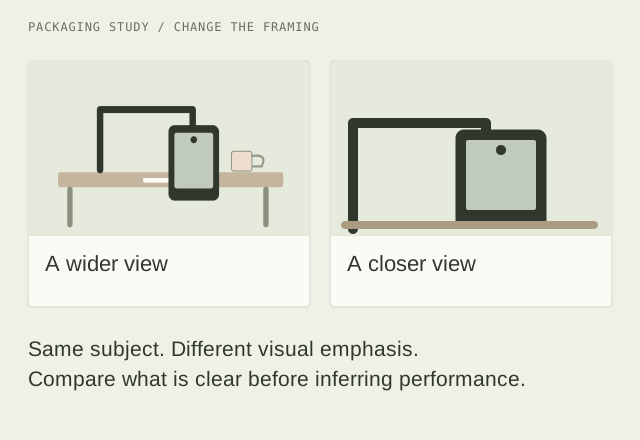
The Thumbnail Teardown: Reverse-Engineering a Competitor’s Packaging in 30 Minutes
A structured way to review a channel’s twelve thumbnails on YouTube, score them against a fixed rubric, and walk away with a packaging pattern you can test instead of a vague feeling that theirs "look better".
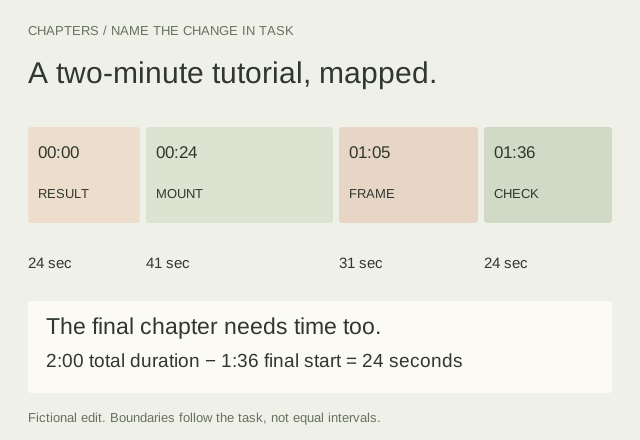
Plan Useful Chapters for a Finished Video
Map a two-minute edit, name the changes in task and check the final chapter as carefully as the first. Includes a blank chapter worksheet.