Plan a YouTube packaging test you can learn from
A test is easier to interpret when the decision is clear before the numbers arrive. Start with an accurate viewer promise, make each variant express a different hypothesis, and decide what you will do if the result is inconclusive.
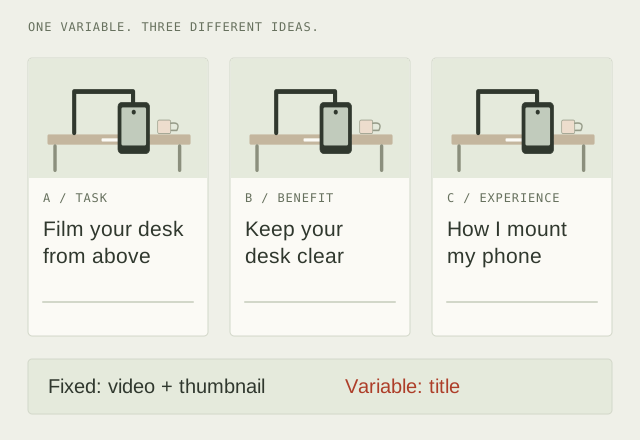
Your output: three variants and an evaluation brief. Use the Packaging Test Planner or download the blank brief. The sample here is invented to demonstrate experiment design; it contains no measured lift or guaranteed outcome.
What YouTube's native test does
YouTube's current A/B test titles & thumbnails documentation describes testing up to three options and evaluating results using watch-time share. It distinguishes a winner, options that performed similarly and an inconclusive outcome. Check that page and your Studio account for current eligibility and available controls.
The September 2025 product announcement put title testing alongside expanding AI and creator tools. That makes generating more ideas a less distinctive advantage than knowing what each idea is supposed to test. This is our product judgement: better experiment notes remain useful as drafting becomes easier.
YTGrid helps write the brief. It does not connect to Studio, split impressions, collect analytics or decide statistical significance.
1. Write the promise in one sentence
For a fictional overhead-phone tutorial, the promise is: “Build an overhead filming setup while keeping the desk usable.” Before proposing a title, point to the demonstration that pays off that promise. If the video never measures stability, a claim such as “perfectly stable” is not supported. If it never compares prices, “cheapest” is not established.
Define the viewer too. A teacher filming a paper demonstration may care about free desk space; a camera enthusiast may care about optics. A title for one is not automatically a good test for the other.
2. Choose the variable
For a title-only test, hold the thumbnail constant. For a thumbnail-only test, hold the title constant. A combined package test can be useful when words and image depend on each other, but the result compares packages: it cannot isolate how much of the difference came from the title or the image.
The planner checks for mismatches in these fields. It compares your written descriptions, so two different descriptions of the same image may still trigger a reminder. This is a prompt for review, not an automated judgement about the actual artwork.
3. Give each option a reason to exist
| Fictional title | Hypothesis | Evidence needed in the video |
|---|---|---|
| Film Your Desk from Above: A Phone Setup Walkthrough | A direct task description makes the instructional purpose clear. | A complete setup walkthrough. |
| An Overhead Phone Setup That Keeps Your Desk Clear | The space-saving benefit is the viewer's main concern. | A visible demonstration of the usable desk area. |
| How I Mount a Phone Above a Small Desk | A first-person demonstration sets an appropriate expectation about the evidence. | The creator's actual setup and its limits. |
All three use the same fictional thumbnail: the mounted phone, an uncluttered desk and a small view of the resulting frame. These titles test task clarity, a benefit and the scope of a personal demonstration. Three versions of “best phone setup” with different punctuation would offer a weaker explanation for any result.
4. Write the decision rule before running the test
Record which native test you intend to use, what you are holding constant, and where you will save its final report. Do not invent a universal impression threshold or stop as soon as a preferred option moves ahead. Follow the native test's result and document its context.
For this fictional brief, the rule is: use the reported result if a clear winner emerges and its promise remains accurate; otherwise choose the clearest accurate package and keep the uncertainty in the log. Accuracy is still required even if an exaggerated variant appears to attract attention.
5. Read the result without changing the question
A winner supports the reported comparison in that test's context. It is not proof that the same wording will win on every video. Similar performance can mean your options make little practical difference for the tested audience. Inconclusive means you should retain uncertainty; the first option being applied by default does not make it the winner.
YouTube's CTR guidance explains why audience and traffic source affect the number. A high CTR from a small, familiar audience is not interchangeable with a lower CTR from wider distribution. Keep impressions, audience context and the native test outcome together instead of reducing the result to one percentage.
Why manual title swaps are weaker evidence
If you show title A on Monday and title B on Friday, you have also changed the time, the viewers who were available and possibly the traffic mix. The difference can still suggest a question worth testing, but it is not a controlled estimate of B's effect. Record it as an observation in the research worksheet, with those other explanations.
A public competitor's successful upload is similarly a source of ideas, not a controlled test of its packaging. You cannot see which alternative thumbnail would have worked, or how many impressions it received.
A useful closing note
End the brief with what you learned, what remains unknown and the next small decision. Avoid turning a single outcome into a permanent title formula. Export the brief alongside the native report so the original hypothesis survives the temptation to explain the result after the fact.