The Creator Brief: What to Specify, and What You Must Never Dictate
There is a reliable way to make a sponsored segment fail: send the creator a script. The audience will notice within four words, because they have spent hundreds of hours learning what this person sounds like and a marketing department does not sound like that. What you bought was a trusted voice, and a script is an instruction to stop using it.
Method and evidence: This is an editorial planning framework, not a survey of market rates or a validated audit model. Numerical scenarios are illustrative; they are not measured campaign results. The platform disclosure source below does not establish the effectiveness of this framework or replace local requirements.
The briefs that work invert the usual instinct. They are exacting about what the segment must achieve and about the handful of things that are non-negotiable, and they leave everything else to the person who knows the audience. This piece sets out where that line sits and gives a full brief structure.
- Specify outcomes, claims, and legal requirements. Do not specify wording, structure or tone.
- Every mandatory phrase you add reduces how natural the read sounds — spend them carefully.
- Approval should cover accuracy and compliance, not style.
- The brief is also the document that protects you when something goes wrong.
Why scripted reads underperform
Three mechanisms, all of them working against you at once.
Register mismatch. Every creator has a vocabulary, sentence length and rhythm their audience has become tuned to. Corporate copy has different ones. The shift is detectable in a sentence or two, and once detected, the viewer's stance changes from listening to enduring.
The performance tax. Reading unfamiliar text aloud sounds different from speaking. Even skilled creators lose fluency reading someone else's phrasing, and the audience reads that stiffness as insincerity whether or not the endorsement is genuine.
Loss of the actual asset. A creator who has used the product knows which specific thing about it will land with their audience — and it is frequently not the feature the brand leads with. A script prevents that knowledge from reaching the video, which means you have paid a premium for expertise and then forbidden its use.
The test: could this segment appear on another creator's channel with only the name changed? If yes, you have bought reach at a specialist's price. The segment should be unusable elsewhere.
The line: outcomes versus execution
| Specify tightly | Leave to the creator |
|---|---|
| What the viewer should understand and be able to do afterwards | The words used to get them there |
| Claims that must be accurate, and claims that must not be made | Which benefit to lead with |
| The offer, code, link and its expiry | How and when the call to action is delivered |
| Minimum duration and the approximate placement window | Exact timestamp, framing and transition |
| Disclosure requirements | The phrasing of the disclosure, within legal bounds |
| Correct product name, spelling and pronunciation | Tone, humour, whether the segment is scripted or improvised |
| Brand-safety limits on the surrounding content | The subject and format of the video itself |
| Deadlines and delivery dates | Production approach and editing style |
A brief structure that works
1The one-sentence objective
What this campaign is for, in a single sentence, in plain language. "We want developers who already use a competitor to know we now support their workflow." Not "drive awareness and consideration." The creator makes hundreds of small decisions while producing the segment; this sentence is what they resolve them against.
2Who the viewer is, from your side
Tell them what you know about the buyer that they might not: what the alternative usually is, what objection comes up most in sales conversations, what the moment of realisation typically is. This is genuinely useful raw material and it is the section most brands skip in favour of a demographic slide.
3The single most important thing
One idea the viewer must retain. Not three, and not a feature list. If everything is important, the creator will distribute the emphasis evenly and nothing will land. Choosing this is your job, not theirs.
4Claims: permitted, required, prohibited
Be explicit. Which claims are substantiated and can be made freely; which specific wording is legally required (and why); which claims must not be made, including ones that sound flattering but are unsubstantiated. Explaining the reason for a restriction dramatically improves compliance — a creator who understands that a claim is a regulatory issue will respect it, while one who thinks it is a preference will paraphrase around it.
5Mandatory elements, kept short
The product name spelled correctly, the URL, the code, the offer terms, the expiry. Every additional mandatory element makes the segment more stilted, so treat this list as a budget. If it has more than five items, cut it.
6Disclosure requirements
State plainly that the segment must be disclosed as paid promotion, both through the platform's paid-promotion setting and audibly or visibly in a way the audience will notice. Do not leave this to be inferred, and do not let a creator hide it in a description. Rules are set by advertising regulators and vary by jurisdiction, so name the standard that applies to your market. This protects the brand as much as the creator.
7Placement guidance, not placement instructions
"Somewhere in the first half, at a natural break" is useful. "At exactly 2:30" is not, because the creator knows where their video's natural seams are and you do not. If early placement matters to you, say why — retention at the integration point is a legitimate commercial concern and most creators will engage with it constructively.
8Approval scope, stated up front
Say exactly what you will review and on what grounds. "We will check factual accuracy, claims compliance, and correct use of the offer terms. We will not request changes to tone, humour or structure." Writing this down prevents the most common failure mode in creator relationships: a review process that starts as compliance and drifts into rewriting.
9Practicalities
Deliverable format, deadline, publication window, who to contact for questions, payment terms and date. Boring, and the source of most disputes. A single named contact who can answer questions within a working day is worth more to the outcome than another page of creative direction.
Two clauses worth reconsidering
Full-video approval
Asking to approve the entire video, rather than the sponsored segment, is a significant editorial intrusion. Most experienced creators will refuse, and the ones who accept are telling you something about how they treat their audience. Reasonable brand-safety conditions — no sponsorship on videos covering defined sensitive topics — achieve the protection without the overreach.
Guaranteed performance
Contractual view guarantees look like risk transfer and mostly produce bad behaviour: creators pushing the video through channels that inflate views without engagement, or padding placement to hit numbers. Creators do not control distribution. If you need volume certainty, buy multiple placements instead of guaranteeing one.
How to give feedback without wrecking the read
When you do review a draft, the framing determines the outcome. Feedback expressed as a problem lets the creator solve it in their own voice; feedback expressed as a replacement sentence produces a scripted line in the middle of an unscripted segment, which is audibly worse than either.
- Instead of "change this to 'the leading platform for X'" — "that phrasing implies a market position we can't substantiate; can you convey the capability without the superlative?"
- Instead of "mention the free tier at the start" — "we're finding the free tier is what converts; worth landing earlier if it fits."
- Instead of "this joke doesn't fit our brand" — nothing at all, unless it creates a genuine problem. You said you would not comment on tone.
And when the draft is good, say so specifically. Creators are choosing which brands to work with again, and the ones who are easy to work with get better placements and better rates next time.
Frequently asked questions
Sources and scope
- YouTube: paid-promotion disclosures and restrictions — platform requirements when a video contains a commercial relationship.
The linked documentation supports platform definitions and features. The article’s practical framework is YTGrid’s editorial reasoning. For a record you can inspect, use the research worksheet and worked example.
A 12-Point Audit for Vetting a YouTube Creator Before You Pay Them
Subscriber count tells you almost nothing. This is the checklist media buyers use to separate a channel with a real audience from one with a big number, using only public data.
Brand & InfluencerInvestigating YouTube Sponsorship Results Beyond Tracking Links
A framework for recording attributed results, self-reported discovery, alternative explanations and uncertainty in campaign measurement.
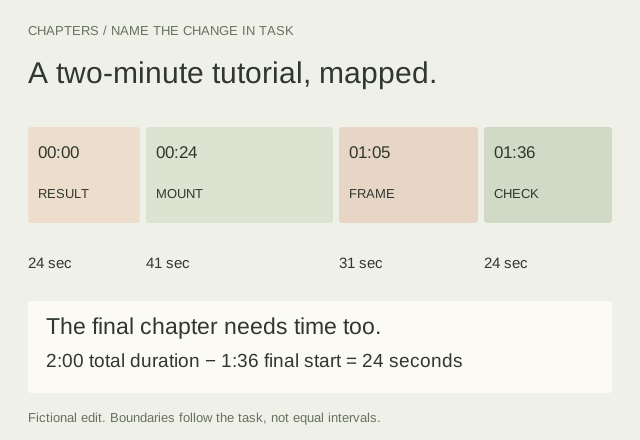
Plan Useful Chapters for a Finished Video
Map a two-minute edit, name the changes in task and check the final chapter as carefully as the first. Includes a blank chapter worksheet.