A 12-Point Audit for Vetting a YouTube Creator Before You Pay Them
Subscriber counts alone do not establish audience fit or likely campaign delivery. For example, two hypothetical channels can have very different recent viewing patterns despite the larger one having more subscribers. Assess the actual audience, comparable uploads and proposed integration before drawing a commercial conclusion.
Method and evidence: This is an editorial planning framework, not a survey of market rates or a validated audit model. Numerical scenarios are illustrative; they are not measured campaign results. The platform disclosure source below does not establish the effectiveness of this framework or replace local requirements.
Everything below can be done from the outside, in about forty minutes per creator, using publicly visible information. It is the work that should happen before any conversation about rates.
- Views-to-subscriber ratio and its trend tell you more than any absolute number.
- Watch a full sponsored segment before deciding. It is the actual product you are buying.
- Comment quality is the cheapest authenticity signal available, and the hardest to fake convincingly.
- Audience fit beats audience size at almost every budget level.
Part one: is the audience real and active?
1Recent views against subscriber count
Take the last ten regular uploads (excluding Shorts and livestreams, which distort the picture) and find the median view count. Compare that to the subscriber number. There is no universal healthy ratio — it varies enormously by niche and channel age — but a channel delivering around 1% of its subscriber count per video is in very different shape from one delivering 30%. A very low ratio usually means an old audience that has drifted away, not fraud.
2The trend, not the snapshot
Now look at the same ratio a year ago. A channel on the way up and a channel on the way down can show identical numbers today, and they are completely different investments. Rising channels are also usually underpriced relative to what they will deliver by the time your campaign runs.
3Consistency of delivery
Spread out the last ten videos and look at the variance. A channel where every video lands between 40,000 and 60,000 views is a predictable media buy. A channel with two videos at 900,000 and eight at 12,000 has an average that describes none of its videos. You will be quoted on the average and delivered the median.
4Comment quality
Read thirty comments on a recent video. You are looking for specificity — do people reference things that actually happened in the video, ask follow-up questions, disagree, bring their own experience? Generic praise ("great video!", "love your content", emoji strings) in volume, particularly on a video with modest views, is a warning sign. Real audiences argue.
5Whether the creator is present
A creator replying to comments substantively — not just hearting them — has a relationship with their audience rather than a viewership. That relationship is precisely what you are paying a premium for over paid media. If it is absent, you are buying reach, and reach can be bought more cheaply elsewhere.
Part two: is this audience your audience?
6Geography
You cannot see a channel's analytics, but you can infer a great deal: the language, currency and units used, which retailers get mentioned, where the comments are written from, whether the creator references local events. A channel whose audience is 70% outside your shipping footprint delivers 30% of the views you are paying for. Ask for the geographic split in the media kit and check it against your own reading.
7Topical adjacency
Does the channel's subject matter sit next to a decision your product is part of? A woodworking channel is adjacent to tool purchases; it is not adjacent to accounting software just because the creator runs a small business. Weak adjacency is the most common reason a technically well-executed campaign returns nothing.
8Audience life stage
Read the comments for signals about who these people are — students, professionals, parents, retirees. A large audience with no money for your category is not a market. This is qualitative and imprecise, and it is still more accurate than assuming your buyer persona applies.
Part three: what will the sponsored segment actually be like?
9Watch three previous sponsored segments in full
This is the most important item on the list and the one most often skipped. Find three past sponsorships and watch each segment start to finish. You are assessing: does the creator sound like they used the product, or like they are reading? Is the integration placed somewhere people are still watching? Is the call to action specific? Does the transition feel like a betrayal of the video or a natural part of it?
Review the selected segments one after another on their original pages so you compare the evidence directly. Keep a research worksheet beside you, with a source link and timestamp for each observation.
10Sponsorship density and category conflicts
Count how many recent uploads contain sponsorships, then inspect the integrations and any audience feedback. Frequency alone does not prove that viewers skip them. Check relevant category conflicts and ask the creator about existing commitments instead of inferring contractual terms from public videos.
11Disclosure practice
Do past sponsorships carry clear disclosure — the paid-promotion label, a verbal statement, or both? A creator who discloses properly is protecting you as much as themselves. Undisclosed paid promotion is a regulatory exposure for the advertiser, not only for the creator, and "we didn't know" is not a defence anywhere it matters.
12Brand safety across the catalogue
Look beyond the recent uploads. Scan the back catalogue and any linked social accounts for content that would be a problem if a journalist found it attached to your brand next quarter. This is not about policing opinions; it is about knowing what you are associating with before you associate with it. Do it yourself rather than delegating it to a tool — context matters and automated flags miss most of what actually causes problems.
On media kits: treat them as a claim, not a source. They are produced by the person selling to you, and they are usually built from the creator's best period rather than their median. Ask specifically for median views over the last ten videos and a screenshot of the geography breakdown. A professional creator will have both ready; hesitation is itself informative. The creator's side of this negotiation is covered in our piece on building a rate card.
Scoring it
Score each of the twelve points from 0 to 2 — fail, acceptable, strong — and total them. The number itself is arbitrary; what makes it useful is that it forces the same questions in the same order across every creator you evaluate, so your comparisons are not driven by which media kit was prettiest.
| Total | Reading | Action |
|---|---|---|
| 19–24 | Strong fit with a real, engaged, relevant audience. | Proceed. Consider a multi-video package rather than a single test. |
| 13–18 | Workable, with identified weaknesses. | Single test video. Write the brief to compensate for the weak points. |
| Below 13 | The numbers may look fine but the underlying audience does not support them. | Pass, regardless of the follower count. |
| Any zero on points 11 or 12 | Disclosure or brand-safety failure. | Automatic pass. These are not tradeable against a good price. |
What this audit deliberately does not do
It does not attempt to predict conversions. Nothing visible from outside a channel will tell you whether an audience buys, and any tool claiming to score that precisely is estimating. The only reliable way to find out is a small paid test with proper measurement — which is a separate discipline covered in measuring sponsorship ROI.
What the audit does is eliminate the expensive obvious mistakes: the dead audience, the mismatched geography, the creator whose reads nobody listens to, the brand-safety problem you did not check for. That is most of the money most brands waste, and it costs forty minutes to avoid.
Frequently asked questions
Sources and scope
- YouTube: paid-promotion disclosures and restrictions — platform requirements when a video contains a commercial relationship.
The linked documentation supports platform definitions and features. The article’s practical framework is YTGrid’s editorial reasoning. For a record you can inspect, use the research worksheet and worked example.
The Creator Brief: What to Specify, and What You Must Never Dictate
The briefs that produce great sponsored segments are strict about outcomes and loose about execution. Here is the line between the two, and a full brief structure you can copy.
Brand & InfluencerInvestigating YouTube Sponsorship Results Beyond Tracking Links
A framework for recording attributed results, self-reported discovery, alternative explanations and uncertainty in campaign measurement.
Plan Useful Chapters for a Finished Video
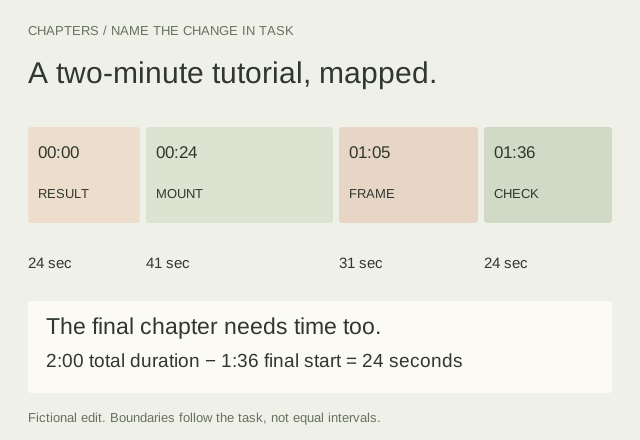
Map a two-minute edit, name the changes in task and check the final chapter as carefully as the first. Includes a blank chapter worksheet.