Study a YouTube Opening: A Hook Analysis Worksheet
A viewer who clicks your thumbnail has not yet agreed to watch your video. They have agreed to sample it. The opening seconds are where that sample either converts into a session or gets abandoned for whatever else the sidebar is offering — and the drop is steeper than most creators realise, because it happens before the intro music has finished playing.
Method and evidence: The rubric and timings here are editorial suggestions for studying a video. They are not a measured retention dataset or a prediction of performance. Public competitor videos do not reveal private CTR or audience-retention reports.
The frustrating part is that the fix is rarely "be more energetic." Openings that hold people are doing several specific jobs in a very short window, and the ones that fail usually skip one of them. This piece breaks the opening into its component parts, shows what each part is for, and ends with a method for taking apart any hook you admire so you can see the structure underneath it rather than just the vibe.
Why the opening is a different job from the rest of the video
The body of a video is written for someone who has decided to stay. It can afford context, nuance, a slow build. The opening is written for someone who has decided nothing at all, is half-listening, possibly has another tab open, and whose default action is to leave. Those are different audiences with different tolerances, and writing them in the same voice is the single most common structural mistake in creator scripting.
An early departure means the viewer will not reach the explanation that follows. That makes the opening a useful place to inspect the match between the package and the content. It does not establish a special moment when YouTube decides the entire future of the video; use the documented retention report and your own observations.
A useful reframe: the thumbnail and title made a promise. The opening's entire job is to confirm, in the fastest way possible, that the promise is about to be kept. Everything else in the hook is in service of that confirmation.
The three questions a viewer is silently asking
Watch someone browse YouTube and you will see them abandon videos in under five seconds without any visible deliberation. They are not being rude. They are running a very fast check, and it resolves to three questions:
- "Is this the thing I clicked for?" The opening has to visibly match the packaging. A thumbnail showing a flooded basement followed by ninety seconds of channel branding creates a mismatch, and the viewer resolves mismatches by leaving.
- "Is this going to be worth the time?" They are estimating payoff against duration. A ten-minute video needs to signal a bigger reward than a three-minute one, and it needs to signal it early.
- "Can this person deliver it?" Not credentials in the formal sense — a signal that you have actually done the thing. Showing the finished result, the messy workshop, the scoreboard, or the receipts answers this faster than any sentence about your qualifications.
These three questions are a useful review checklist. A cinematic sequence may answer them well or poorly; the checklist alone cannot establish which version retains more viewers. Compare the actual opening with your own audience evidence.
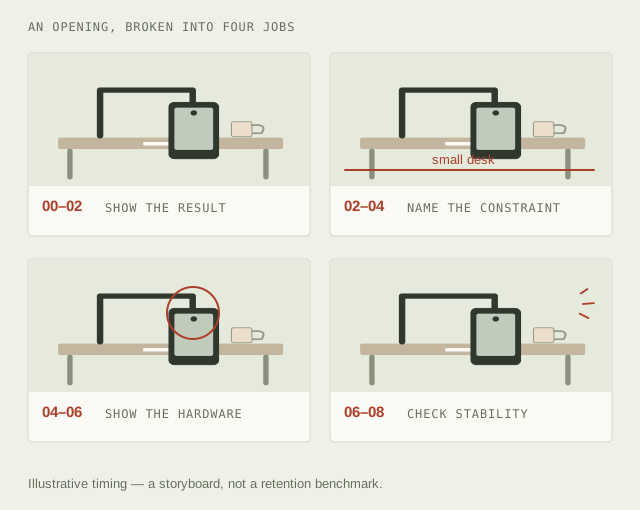
A fictional eight-second storyboard
This invented desk-camera tutorial shows how to label an opening. These timings are a design example, not a measured retention recommendation.
| Time | Picture and narration | Job to inspect |
|---|---|---|
| 0–2 seconds | A finished overhead shot of a paper demonstration. | Show the outcome before describing the equipment. |
| 2–4 seconds | A wide shot reveals the small desk: “I need to film this without losing the work surface.” | State the practical constraint. |
| 4–6 seconds | A close view of the mounting point. | Show what the tutorial will explain. |
| 6–8 seconds | Typing makes the mount wobble: “Then we will check what moves.” | Introduce a limit the demonstration must address. |
A comparison should ask whether those jobs are clear, whether the video delivers them and what necessary context is missing. Whether this sequence retains viewers better requires audience evidence; the storyboard alone cannot answer that.
The five components of a working hook
Dismantle enough strong openings and the same five parts keep appearing. Not every video uses all five, and the order varies, but the parts themselves are remarkably consistent.
1The cold open
The first shot arrives mid-situation, with no preamble. Something is already happening: the machine is running, the argument is underway, the result is on screen. A cold open works because it borrows the viewer's curiosity rather than asking for their patience — they now need context, and the only way to get it is to keep watching. The key constraint is that the cold open must come from the actual video. Lifting a dramatic moment that never gets explained is the fastest way to train an audience to distrust your openings.
2The stake
Within a few seconds, the viewer needs to know what is at risk or what is being gained. Stakes do not have to be dramatic — "if this fails I lose the deposit," "by the end of this you will be able to read the first line of your analytics dashboard and know what to fix" both work. What matters is that something is on the line. Videos without stakes feel like they could be stopped at any point without loss, and viewers act on that feeling.
3The credibility beat
One short signal that you are the right person to watch. The strongest version is demonstration, not assertion: showing the wall you already tiled rather than saying you are a tiler. Keep the evidence relevant to the promised task. A long credential list may delay the demonstration; whether that matters depends on the audience and the information they need.
4The roadmap
A compressed sense of the shape of what follows: "three tests, one of them broke the machine." This is not a table of contents; it is a reassurance that the video is going somewhere and that the route is short. Roadmaps matter more as video length increases — a twenty-minute video without one asks for a great deal of blind trust.
5The re-hook
The most overlooked component. After the initial question has been partly answered, consider whether the viewer has a reason to continue. There is no universal second drop-off timestamp. Strong videos plant a new open loop right before it: a complication, a question that has not been answered yet, a "but there was a problem with that." Treat the placement as a hypothesis to investigate in the actual video, not a guaranteed improvement in retention.
Six hook archetypes and what each one costs
Most openings are a variation on a small number of shapes. Each shape buys attention in a different currency, and each has a cost that shows up somewhere else in the video.
| Archetype | How it opens | What it costs you |
|---|---|---|
| Result-first | Shows the finished outcome immediately, then rewinds to how it happened. | Spends your best visual in the first five seconds. The middle must have its own payoffs or it sags badly. |
| Contradiction | States something the audience believes, then denies it. | You now owe a genuine, well-evidenced reversal. A weak one reads as bait and damages trust for future videos. |
| In-progress | Drops into the middle of an action already underway. | Requires you to backfill context without it feeling like the intro you avoided. |
| Direct problem | Names the viewer's exact frustration in their own words. | Narrows the audience to people who already have that problem. Excellent for search traffic, weak for browse. |
| Stakes-and-rules | Sets up a challenge with explicit constraints and a clear win condition. | Locks your structure. Breaking your own stated rules mid-video is very visible to an audience. |
| Question | Poses a genuine unanswered question the video will resolve. | The weakest of the six if the question is rhetorical or obviously answerable. Only works when the answer is truly non-obvious. |
Four ways openings fail
The warm-up
"Hey guys, welcome back to the channel, hope you're having a great week, so today we're going to be looking at..." Every word before "today" is throat-clearing. It is comfortable to record and expensive to keep. Greetings are not forbidden, but they belong after the hook has landed, not before it.
The mismatch
The packaging promised a dramatic comparison; the opening delivers a slow tour of your desk setup. Even if the comparison arrives at minute four, most of the audience will not. Openings must confirm the specific promise the thumbnail made, not a general promise of quality.
The over-explained premise
Some creators front-load every caveat and definition out of a fear of being misunderstood. The result is an opening that spends its most valuable seconds on qualifications no one has asked for yet. Caveats survive perfectly well in the middle of a video, where the remaining audience is invested enough to want them.
The delayed payoff with no bridge
A promise that will not be honoured for eight minutes needs something to hold the gap. This is what the re-hook is for. Videos that open strongly and then flatline usually have a good hook and no bridge behind it.
A quick diagnostic: mute your own video and watch the first ten seconds. If you cannot tell what it is about from the visuals alone, your opening is carrying all its weight in narration — and narration is exactly what a half-attentive viewer processes last.
How to study a hook frame by frame
Reading about hook structure helps less than dismantling twenty real ones. The problem is that openings are short and dense: at normal speed you experience the effect but you cannot see the mechanism. The fix is repetition — watching the same eight seconds enough times that you stop reacting to it and start noticing how it is assembled.
Here is a routine that takes about fifteen minutes per video:
- Pick well-matched examples. Choose videos from your own niche that clearly outperformed the channel's baseline. A hook that works for a 20-million-subscriber entertainment channel may rely on recognition you do not have.
- Isolate the opening. Review roughly the first fifteen seconds on the original video page. Record the start and end of the passage so each viewing examines the same material.
- First pass — count the shots. Ignore the words entirely. How many distinct shots are there before the title card? Where is the first cut? Shot count in the opening is a surprisingly reliable signal of how much visual momentum a creator is buying.
- Second pass — examine the wording. Note the key opening lines and their timestamps in your own notebook. Seeing the words separately from their delivery helps you judge what information each sentence adds.
- Third pass — label the components. Mark where the cold open, stake, credibility beat and roadmap appear, and note which are missing. Most strong hooks use three of the five, not all five.
- Fourth pass — find the re-hook. Extend your loop out to about 0:45 and look for the moment a new question is opened. Note the timestamp.
After a small comparison, you have a record of how the selected videos open. You do not yet have proof of what caused their results or what your audience prefers. Keep the selection rule, include counterexamples and use the patterns as hypotheses for your own work.
Keep a record you can check
Review each passage on its original page and note the source, timestamp and observation.
Download the research worksheetRewriting your own opening
When you turn the analysis back on your own work, resist the urge to rewrite from scratch. Run through a short checklist instead:
- Does the first sentence contain any information, or is it a greeting in disguise?
- Would someone who muted the video know the subject within ten seconds?
- Is the specific promise from the thumbnail visibly confirmed before the fifteen-second mark?
- Is there a stake — something gained or lost?
- Is there a second open loop planted before the forty-second mark?
- Have you cut every word that exists to make you comfortable rather than the viewer curious?
Most openings improve dramatically by deletion alone. The common outcome of this exercise is not a better first line but a first line that arrives eleven seconds earlier.
Frequently asked questions
Sources and scope
- YouTube: audience-retention reports — what the report can show for your own videos.
- YouTube: title and thumbnail tests — native testing and the meaning of its results.
The linked documentation supports platform definitions and features. The article’s practical framework is YTGrid’s editorial reasoning. For a record you can inspect, use the research worksheet and worked example.
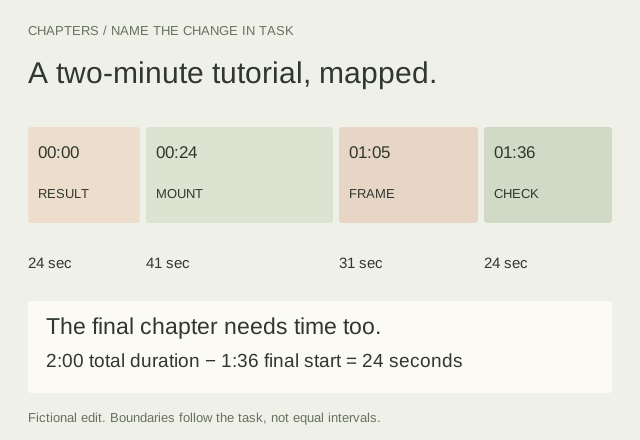
Plan Useful Chapters for a Finished Video
Map a two-minute edit, name the changes in task and check the final chapter as carefully as the first. Includes a blank chapter worksheet.
Build a Shot List Around What Each Image Needs to Do
Turn a viewer promise into a visual sequence. A fictional fourteen-second plan connects framing, audio, purpose and estimated runtime.
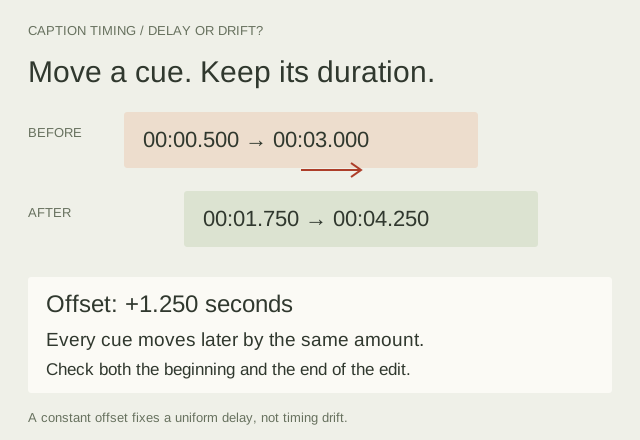
Fix Caption Timing Without Losing the Meaning
Read an SRT cue, distinguish a constant offset from drift, review overlaps and export a caption draft you can check against the final edit.