Compare CTR and Retention Without Mixing Audiences
A title can attract a click and still set the wrong expectation. But a falling click-through rate does not automatically mean the title got worse, and an improving retention curve does not prove that a new thumbnail caused it.
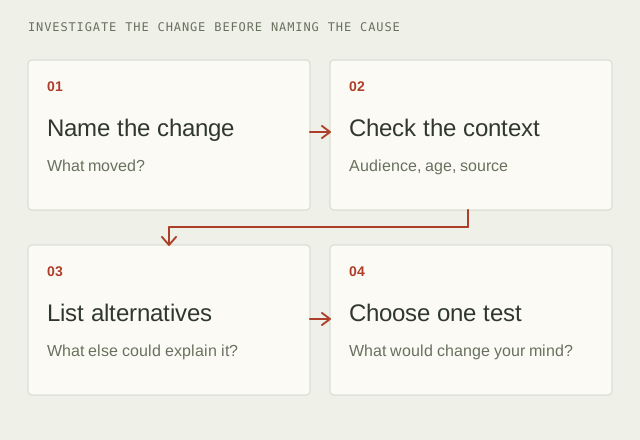
Revision note: the earlier title suggested that improving CTR usually damages retention. That is not a universal relationship. This version separates a possible promise mismatch from changes in audience and traffic source.
Start with the populations
YouTube's CTR FAQ defines impressions click-through rate around counted thumbnail impressions. Not every external appearance of a video is counted in that measure. The audience-retention report concerns viewers who started watching. You are not looking at the same population twice.
Suppose a fictional tutorial has a high CTR among people searching for its exact topic. Later it reaches more casual home-page viewers, and aggregate CTR falls. The packaging has not changed. Audience composition is an alternative explanation that should stay in your analysis.
When a promise mismatch is plausible
A package promising a finished result in five minutes sets a particular expectation. An opening that spends several minutes on an unrelated story may violate that expectation. You can inspect the mismatch directly, but its effect on retention still needs evidence. The presence of a mismatch is not a measurement of the viewers who left because of it.
Use the research worksheet to record the exact title promise, the first moment the video addresses it and any information the viewer needs before that moment. A slower introduction may be appropriate when safety, context or definitions are necessary.
Use a comparison log
| Record | Why it matters |
|---|---|
| Video age and observation period | A launch audience may differ from a later audience. |
| Traffic source and format | Search, browse and Shorts are different viewing contexts. |
| Packaging and edit changes | Several changes together make attribution harder. |
| Native test result, if used | A controlled comparison is stronger evidence than a manual before/after swap. |
| Alternative explanations | Topic demand and audience differences can explain a movement without a packaging effect. |
Test a specific packaging hypothesis
Write the hypothesis before creating alternatives. For example: “A title that states the desk-space benefit will communicate this tutorial's purpose more clearly than a generic setup title.” Keep the thumbnail constant if that is a title-only test.
YouTube's native title and thumbnail testing documentation describes its own outcome measure and possible result categories. Use that report instead of choosing whichever variant happens to show the highest CTR in a separate aggregate view. An inconclusive result should remain inconclusive in your notes.
The Packaging Test Planner helps record the variants, constants and decision rule. It does not calculate significance or retrieve private metrics.
A fictional result and a careful conclusion
Imagine a native test reports similar performance for three accurate titles. The useful conclusion is that this test did not establish a clear advantage among those options. It is not evidence that titles never matter, that a particular phrasing is a permanent winner or that the video needs a more exaggerated promise.
Choose the clearest accurate option, record the tested hypotheses and look for a new question. A retention dip around a confusing demonstration could warrant investigating the explanation itself. That is a different problem from click-through and should be treated as a separate decision.
Can both metrics improve?
They can move in the same direction or different directions. A clearer and more accurate promise may help the intended viewer decide to click and understand what follows. A change in the audience can also move both metrics without any edit. Treat a causal explanation as a hypothesis until your evidence supports it.
Work through the packaging-test example for a complete brief and a downloadable template.
YouTube Recommendations: What Is Documented and What You Can Test
A source-based explanation of YouTube discovery, the limits of public analytics and a practical workflow for investigating a performance change.
Growth & AlgorithmThe First 24 Hours After Upload: What Matters, and What Is Folklore
Best posting times, comment-reply sprints, the "golden hour". Some of the launch-day advice creators follow religiously has a real mechanism behind it. Most of it does not. Here is the split.
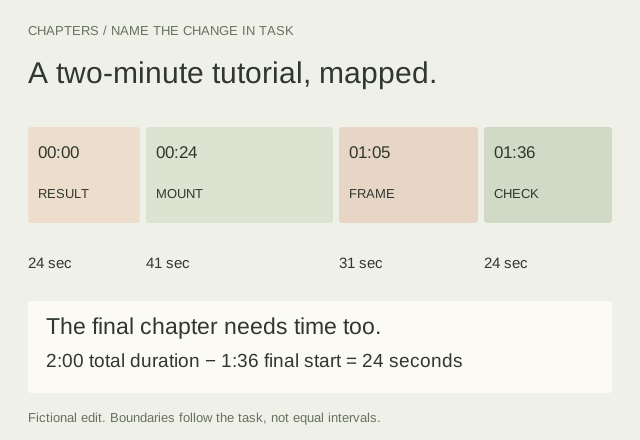
Plan Useful Chapters for a Finished Video
Map a two-minute edit, name the changes in task and check the final chapter as carefully as the first. Includes a blank chapter worksheet.