How to Build a Sponsorship Rate Card You Can Actually Defend
Most creators price their first sponsorship by guessing, then anchor on that guess for years. The guess is usually low, it is usually indefensible when questioned, and it quietly sets the ceiling for every negotiation that follows — because the first thing a returning brand asks is what you charged last time.
Method and evidence: This is an editorial planning framework, not a survey of market rates or a validated audit model. Numerical scenarios are illustrative; they are not measured campaign results. The platform disclosure source below does not establish the effectiveness of this framework or replace local requirements.
A rate card fixes this. Not because it makes you expensive, but because it makes your price explicable. When a brand asks why a dedicated video costs four times an integration, you have an answer that refers to delivery, risk and opportunity cost rather than to how you felt that morning.
- Price from your own recent delivery data, not from follower count.
- Use the median of your last several comparable videos, never the best one.
- Deliverables, usage rights and exclusivity are three separate charges. Most creators give away the last two.
- A rate card is an opening position with defined discounts, not a fixed price list.
Step one: establish your delivery baseline
A sponsor is buying attention from a defined audience. So the first job is to state, honestly and specifically, what you deliver. Pull these figures from your own analytics:
- Median views at 30 days across your last eight to ten comparable videos. Median, not mean — one viral outlier will otherwise make every quote you send undeliverable.
- Median views at 90 days, if your videos have a long tail. Search-led channels often deliver half their eventual views after the first month, and that is value a brand receives for free unless you price it.
- Average view duration, and specifically what share of viewers are still present at the point where an integration would sit.
- Audience geography, top three countries with percentages. A brand that only ships to one market cares enormously about this.
- Audience composition — age bands, and any qualitative knowledge you have about who they are professionally.
Exclude anything unrepresentative: a video that went unusually wide, a collaboration that brought in someone else's audience, anything more than a year old. You are describing what the next video will most likely do, not the best thing you have ever done.
The retention point matters more than the view count. If your integration sits at minute six and only 40% of viewers are still watching at minute six, you are delivering 40% of your views, not 100%. Knowing this — and saying it out loud — makes you look like someone who understands the transaction. It also lets you argue for moving the placement earlier, which is worth more to the brand than a discount.
Step two: set a base rate
The common starting method is a cost per thousand delivered views. Take a rate per thousand, multiply by your median delivery in thousands, and you have a floor.
The rate you pick depends on factors you can reason about rather than look up:
Illustrative planning table: any amounts or multiples below are examples to replace with your own delivery data and costs, not surveyed rates or recommended contract terms.
| Factor | Pushes your rate up when... | Pushes it down when... |
|---|---|---|
| Audience commercial value | Your viewers make or influence expensive purchasing decisions. | Your audience is broad, young, or not in a buying position. |
| Niche specificity | A brand cannot easily reach these people elsewhere. | There are fifty comparable channels a buyer could pick instead. |
| Audience trust | You rarely sponsor, and your recommendations visibly move behaviour. | You run several sponsorships a month. |
| Production burden | The deliverable needs demos, custom filming, or product testing time. | It is a sixty-second read over existing footage. |
| Long tail | Your videos keep earning views for a year or more. | Your content is topical and dies in a week. |
Sanity-check the result against what the brand's alternative would cost. If reaching ten thousand well-matched viewers through paid advertising would cost a brand more than your quote, your quote is defensible — and that comparison is the argument to make if you are challenged. If your figure is wildly above that alternative, you are relying on the brand valuing your endorsement rather than your reach, which is a real argument but a different one, and you should make it explicitly.
Step three: price the deliverables
Different formats consume different amounts of your most limited assets: audience patience and production time. Price them as multiples of your base rate.
Illustrative planning table: any amounts or multiples below are examples to replace with your own delivery data and costs, not surveyed rates or recommended contract terms.
| Deliverable | Typical multiple of base | What justifies it |
|---|---|---|
| Short mention (15–30s) | 0.5× | Minimal production, minimal audience cost, low impact. |
| Standard integration (60–90s) | 1× (this is your base) | The default unit. Everything else is priced relative to it. |
| Extended integration with demo (2–3 min) | 1.5–2× | Real production time, real retention cost, much higher conversion. |
| Dedicated video | 3–5× | You are giving up an entire content slot — including the audience growth that slot would have produced. That opportunity cost is the main justification. |
| Series (3+ videos) | Per-unit discount of 10–20% | Guaranteed volume and reduced negotiation overhead genuinely warrant a discount. |
| Community post / newsletter mention | Small flat fee | Price separately. Bundling it in trains brands to expect it free. |
The dedicated video multiple is the one creators most often underprice. A dedicated video does not cost you one video's production; it costs you the video you would otherwise have made — including whatever audience growth that video would have generated. On a channel where an organic video reliably brings in new subscribers, that forgone growth is a substantial real expense.
Step four: price usage rights and exclusivity
This is where inexperienced creators lose the most money, because these clauses arrive in the contract rather than in the negotiation, and they sound administrative.
Usage rights
A brand asking to use your segment in their own paid advertising is asking for something quite different from what they bought. They are buying your face and voice as advertising creative, running on their budget, in placements you do not control, potentially for years.
Price it separately, and price it against three variables: duration (three months, six, twelve, perpetual), channels (their organic social only, or paid media, or television), and territory. A common approach is a percentage uplift on the base fee that scales with all three — modest for six months of organic social, substantial for twelve months of global paid media. Perpetual, all-media, worldwide rights should cost multiples of the content fee, and you are entitled to simply decline them.
Exclusivity
An exclusivity clause prevents you from working with competitors for a defined period. It has a real cost: it removes a section of your addressable market for that time. Price it by asking what you would plausibly have earned from that category during the period.
Two things to insist on. First, the category must be defined narrowly and in writing — "project management software" rather than "software." A vague category clause can lock you out of half your potential sponsors. Second, the period must be bounded; open-ended exclusivity is not a clause you should accept at any price.
Other clauses worth pricing
- Approval rights over the whole video, not just the sponsored segment — this is a significant editorial concession and should be resisted before it is priced.
- Guaranteed view counts — do not accept these. You cannot control distribution, and a make-good obligation turns a fixed fee into an open liability.
- Content restrictions on the rest of the video — reasonable brand-safety limits are fine; broad editorial control is not.
- Extended payment terms — 90-day terms are a financing cost you are absorbing. Price it or negotiate it down.
Step five: build in your discount structure
Decide your discounts before anyone asks for one. A discount you planned is a negotiating tool; a discount you improvised is a signal that the original number was arbitrary.
- Volume: 10–20% for a committed multi-video package, paid on schedule.
- Payment terms: a small discount for payment on delivery rather than in arrears is worth offering — cash flow has real value.
- Products you already use and genuinely rate: a discount here is legitimate, because the segment will be better and easier to make. Be careful not to let this become your default.
- Never discount for "exposure", affiliate-only arrangements, or a promised future budget. These are not discounts; they are a different deal with no fee.
Holding the price in a negotiation
A few things that consistently help:
- Send the reasoning, not just the number. "£X, based on a median 30-day delivery of Y views with Z% still watching at the integration point" is much harder to haggle with than a bare figure.
- Give up scope before you give up price. If the budget is genuinely fixed, reduce the deliverable — a shorter integration, fewer platforms, shorter usage window. This protects your rate card for the next negotiation.
- Have a walk-away number and know it in advance. The point of doing the maths beforehand is that you can decline calmly instead of talking yourself into a bad deal on a call.
- Ask what the campaign is measured on. If they are optimising for installations rather than awareness, the placement and framing should change — and a creator who asks this question reads as a partner rather than an inventory unit. Our piece on how brands measure sponsorship returns covers what they are usually looking at.
- Disclose properly and say so upfront. Paid promotion must be disclosed to your audience, and any competent brand expects this. Raising it early signals professionalism; the brief is where it should be written down.
Reality check: everything here is a framework for reasoning, not a promise about market rates. Prices vary enormously by niche, region and year, and no article can tell you what your specific audience is worth. What the framework does give you is a number you can explain — which is the actual difference between creators who get their price and creators who get talked down.
Frequently asked questions
Sources and scope
- YouTube: paid-promotion disclosures and restrictions — platform requirements when a video contains a commercial relationship.
The linked documentation supports platform definitions and features. The article’s practical framework is YTGrid’s editorial reasoning. For a record you can inspect, use the research worksheet and worked example.
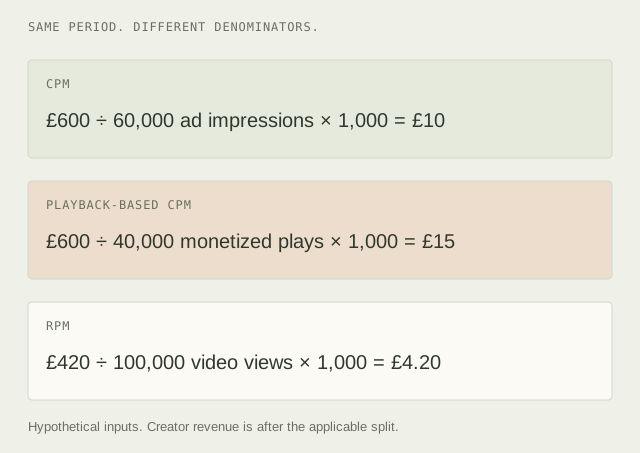
RPM and CPM: Read the Denominator Before the Number
Understand ad impressions, monetized playbacks and creator revenue per thousand views with an explicitly hypothetical calculation and links to YouTube documentation.
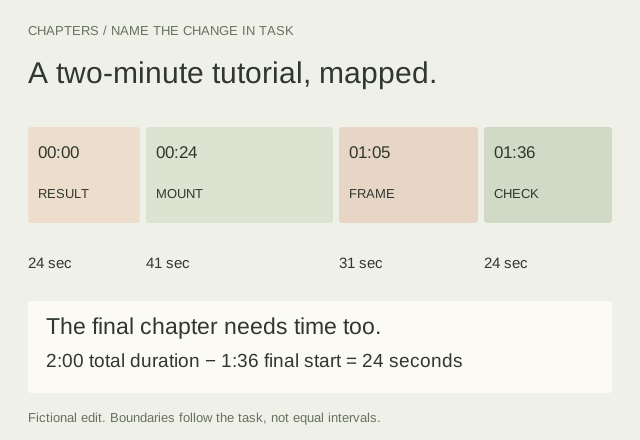
Plan Useful Chapters for a Finished Video
Map a two-minute edit, name the changes in task and check the final chapter as carefully as the first. Includes a blank chapter worksheet.
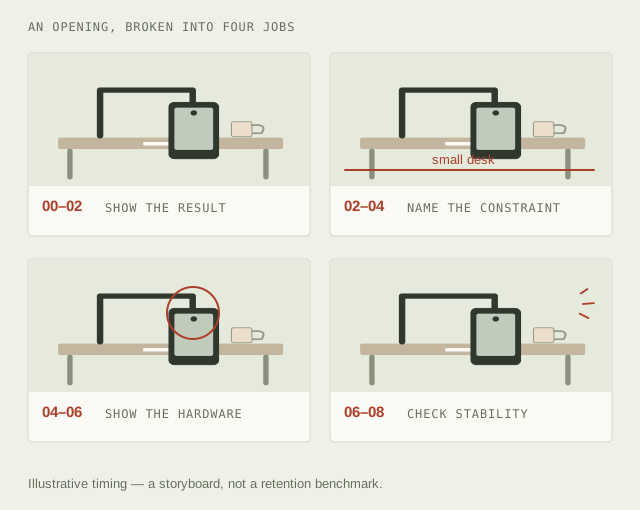
Build a Shot List Around What Each Image Needs to Do
Turn a viewer promise into a visual sequence. A fictional fourteen-second plan connects framing, audio, purpose and estimated runtime.