The Thumbnail Teardown: Reverse-Engineering a Competitor's Packaging in 30 Minutes
"Their thumbnails just look better" is not an insight. It is the feeling you get when you can see that something is working but cannot name the mechanism — and because you cannot name it, you cannot copy the principle, only the surface. A teardown replaces that feeling with a list of concrete decisions you can test one at a time.
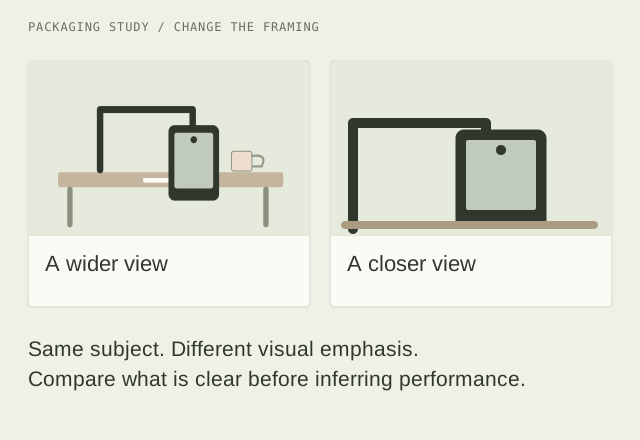
Method and evidence: The rubric and timings here are editorial suggestions for studying a video. They are not a measured retention dataset or a prediction of performance. Public competitor videos do not reveal private CTR or audience-retention reports.
This is a repeatable thirty-minute routine. It works on any channel, requires no paid tools, and ends with a written pattern document rather than a folder of screenshots you will never open again.
- Analyse a channel's outliers, not its average — the videos that beat the channel's own baseline are the only ones carrying information.
- Score against a fixed rubric so your conclusions survive your own taste.
- Look at thumbnails at the size they are actually seen, not full screen.
- The output is a pattern hypothesis with a testable prediction, not a mood board.
Why you analyse outliers, not averages
If you review a channel's twelve most recent thumbnails on YouTube, you learn what that channel's habits are. That is not the same as learning what works. Habits include every decision the creator has never revisited, every constraint imposed by their editor's template, and every superstition they picked up three years ago.
What carries information is the gap between a channel's typical performance and its exceptional performance. When one video on a channel does four times the views of its neighbours, something about that video's packaging, topic or timing was different — and because the audience, the upload cadence and the production quality were held roughly constant, the comparison is much cleaner than comparing two different channels.
You cannot see a channel's click-through rate from outside, but you can see view counts alongside upload dates, and that is enough. A video from eight months ago with 900,000 views on a channel that normally does 120,000 is an outlier worth studying. A video from last week with 40,000 views is not yet comparable to anything — it has not finished.
Watch the age trap. Older videos accumulate views simply by existing. Compare a video only against its immediate neighbours in the upload order, never against videos from a different year. A 2024 video with double the views of a 2026 video may just be two years older.
Step one: gather the set
Pick one competitor — a channel in your niche, similar size or one tier above you. Larger is fine; ten tiers larger is not, because at very large scale the packaging is doing a different job (audiences click on recognition, not on the image).
- Open the channel's Videos tab and sort by Popular. Note the top eight, ignoring anything more than about eighteen months old.
- Switch to recent uploads and choose several lower-view examples alongside the higher-view examples. These are comparison cases, not an experimental control group. Record their age and topic, since public views do not isolate the effect of packaging.
- Review each thumbnail on the original YouTube page. Keep its source link and write a description of the framing, text and focal point in your research notes. Use your own artwork for local image comparisons.
- Record the view count, upload date and title alongside each source link. The title is half the packaging; analysing the image alone will mislead you.
You now have twelve winners-and-losers with their titles. That contrast is the entire value of the exercise.
Step two: score against the rubric
Judge each thumbnail against the same seven dimensions, in the same order, without reference to whether you like it. The rubric exists to stop your own aesthetic preferences from becoming the finding.
| Dimension | What you are recording | Why it matters |
|---|---|---|
| Focal count | How many distinct things compete for attention (0–4+). | At browsing size, more than two focal elements usually reads as noise. |
| Subject scale | Roughly what fraction of the frame the main subject occupies. | Predicts whether the image survives being shrunk to a phone-sized card. |
| Text load | Word count in the image, and whether it repeats the title. | Text that duplicates the title wastes the second channel of information. |
| Contrast strategy | How the subject separates from the background — colour, blur, outline, lighting. | Separation is what makes a thumbnail legible at speed; style is secondary. |
| Emotional register | Face present? What expression? Or object-led with no face? | Faces are not universally better. Some niches consistently reward object-led images. |
| Curiosity mechanism | What is deliberately withheld or made ambiguous. | The single dimension most correlated with outlier performance in most niches. |
| Title relationship | Does the image repeat, extend or contradict the title? | Extension outperforms repetition almost everywhere. Contradiction is high-risk. |
Two practical rules while scoring. First, view each thumbnail at roughly 210 pixels wide — about the size of a card in a real feed. Judging a thumbnail full screen will make you value detail that no viewer will ever see. Second, score all twelve on one dimension before moving to the next. Scoring one image across all seven dimensions at once invites you to build a story about that image, and stories are what you are trying to avoid until the end.
Step three: find the pattern
Lay your scores out and look for dimensions where the eight winners cluster and the four underperformers do not. You are looking for a split, not a majority. If ten of twelve thumbnails have a face, "faces work" is not a finding — it is the channel's template. If seven of eight winners withhold the outcome and three of four underperformers show it, you have something.
Typical findings from a real teardown look like these:
- "Winners show the moment before the result. Underperformers show the result itself."
- "Winners use two or three words of text that are not in the title. Underperformers use five to seven words that restate it."
- "Winners keep a single subject at roughly half the frame height. Underperformers use three-panel comparison layouts that dissolve at small sizes."
- "The three biggest outliers are the only videos where the thumbnail poses a question the title answers, rather than the other way round."
Write the pattern as a sentence with a mechanism attached. "Bright colours perform" is not usable. "Bright colours perform because this niche's competitors all use dark studio backgrounds, so a light background is the only separation available in the feed" tells you what to do when the competitive context changes.
Compare your own draft ideas
Bring your own thumbnail drafts into a small-preview comparison and export a revision brief.
Open the Thumbnail CompareStep four: turn it into a test
A teardown that ends in a document is half-finished. Convert the strongest pattern into a prediction with a number attached, then run it on your next upload.
A useful hypothesis states the variable and the intended effect: “A clearer view of the finished object will better communicate the task.” Run an eligible native title or thumbnail test if you want a controlled packaging comparison. Changing thumbnails across different videos also changes the topic and audience; three uploads alone cannot isolate the thumbnail effect.
Then decide in advance what would falsify it. If your prediction is that reducing text load lifts click-through, and it does not move after three videos, the honest conclusion is that text load was not the mechanism in that channel's success — not that you need to reduce it further.
Keep the documents. After four or five teardowns across different competitors you will start seeing which patterns are niche-wide (worth adopting) and which were one channel's idiosyncrasy (worth ignoring). That accumulated file is more valuable than any single teardown, and it is the reason to write these down rather than doing them in your head.
Mistakes that make teardowns useless
Analysing only winners
Without contrasting examples, it is easy to mistake a channel-wide design habit for a reason one video performed differently. Include comparison cases, while remembering that they are observational and have uncontrolled differences.
Copying execution instead of principle
If a competitor's outliers all use a red arrow, the finding is not "use a red arrow." It is "direct the eye to the specific point of interest." Copying the arrow into a niche that has ten red arrows on screen achieves the opposite of what made it work.
Ignoring the title
Thumbnails are read together with titles, and the strongest packaging usually has the two doing different jobs. A teardown of images alone will keep producing findings that fail to replicate. Our piece on title structures covers the other half.
Sampling too widely
Twelve thumbnails from one channel produce a clear picture. Twelve thumbnails from twelve channels produce a blur, because every difference has multiple possible causes. Do one channel per session.
Frequently asked questions
Sources and scope
- YouTube: audience-retention reports — what the report can show for your own videos.
- YouTube: title and thumbnail tests — native testing and the meaning of its results.
The linked documentation supports platform definitions and features. The article’s practical framework is YTGrid’s editorial reasoning. For a record you can inspect, use the research worksheet and worked example.
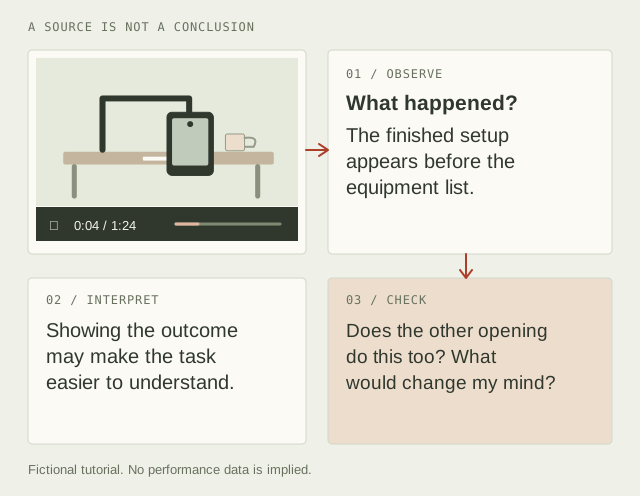
Turn Video Observations into a Research Notebook
Keep timestamped evidence separate from interpretation, check AI-assisted notes and export a notebook. Includes a fictional worked example and a blank worksheet.
The Six-Channel Wall: A Weekly Competitive Research Routine
Ninety minutes a week reviewing six competing channels with one worksheet will teach you more about your niche than a month of guessing. The exact routine, the log format, and how to act on it.
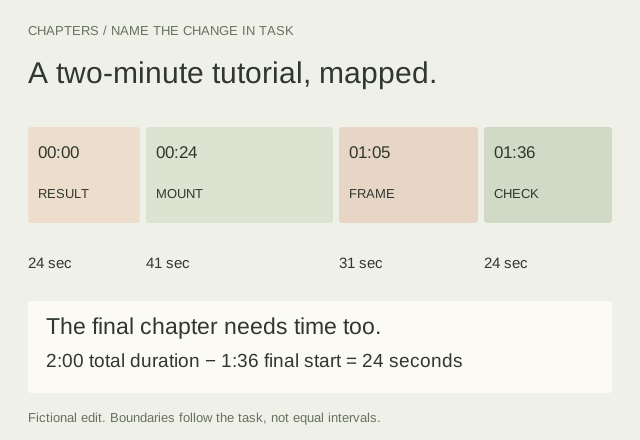
Plan Useful Chapters for a Finished Video
Map a two-minute edit, name the changes in task and check the final chapter as carefully as the first. Includes a blank chapter worksheet.