Nine YouTube Title Structures and Their Trade-offs
Title advice usually arrives as a list of formulas to copy. That is the least useful form it could take, because a formula copied without its mechanism will be applied in the one situation where it does the opposite of what you wanted. Every structure below is presented with two things: why it pulls, and the conditions under which it stops pulling.
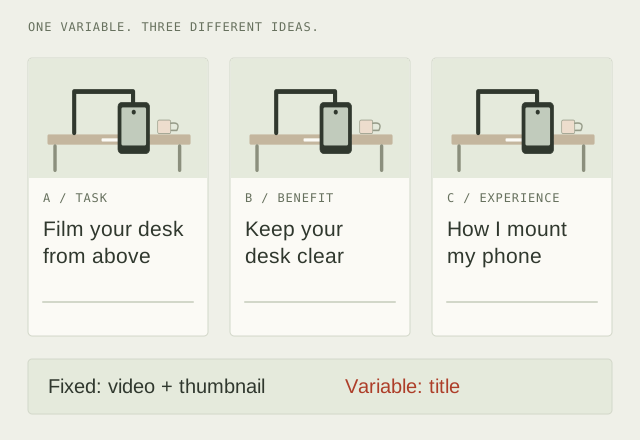
Method and evidence: The rubric and timings here are editorial suggestions for studying a video. They are not a measured retention dataset or a prediction of performance. Public competitor videos do not reveal private CTR or audience-retention reports.
One framing to hold onto throughout. A title is not a description of your video. It is the second half of a two-part promise, the first half being the thumbnail. The best titles are the ones that say something the image cannot, and the most common weak title is one that describes what is already visible.
- A title's job is to create a specific expectation, not to summarise.
- Curiosity works when the viewer can imagine the answer's shape but not its content.
- Every structure has a saturation point — when a niche is full of it, it inverts.
- Search-led and browse-led titles are different crafts; writing one for the other is the most expensive title mistake there is.
First: search titles and browse titles are not the same job
Before any structure, decide which traffic you are writing for. A video that will mostly be found by people typing a query needs the query in the title, close to the front, in the phrasing people actually use. Cleverness here is a liability — "Fixing The Unfixable" will not be found by anyone searching "dishwasher not draining."
A video that will mostly be served on the home page and in suggested feeds is competing for attention against fifteen other cards, and nobody typed anything. Here, specificity of intrigue beats keyword coverage. The same video can rarely be optimised for both, and trying usually produces a title that is too vague to rank and too flat to click.
The practical test: would somebody type roughly this phrase into a search box? If yes, write for search and put the phrase first. If no, write for browse and treat keyword placement as irrelevant.
The nine structures
1The direct instruction
"How to Reset a Boiler Pressure Valve"
Why it works: It matches an existing intent exactly. There is no persuasion involved — the viewer already wanted this and is scanning for the clearest match.
Where it fails: On browse traffic, where nobody has the intent yet. A direct instruction served to a general audience is invisible; it looks like a manual. It also caps your ceiling at the size of the search demand, which for narrow topics may be a few hundred people a month.
2The curiosity gap
"The One Setting That Was Ruining My Photos"
Why it works: It defines a shape — there is a single specific answer, it is knowable, and you do not know it. The discomfort of a nearly-complete pattern is what gets the click.
Where it fails: Two ways. If the gap is too wide ("This Changed Everything") the viewer cannot imagine what the payoff even is, so there is nothing to want. And if the video's answer is mundane, the viewer feels manipulated — retention collapses at the reveal, and repeated offences teach an audience to skip your videos on sight.
3The number list
"Seven Kitchen Layouts That Actually Work in Small Flats"
Why it works: It promises bounded effort. The viewer knows exactly how much is coming and can commit to a defined amount of time. Lists also survive partial watching, which makes them low-risk to click.
Where it fails: Lists produce shallow retention, because each item is a natural exit point. They also cap emotional investment — nobody is gripped by item four of seven. In niches saturated with lists, the number becomes wallpaper and stops signalling anything.
4The negation
"Stop Sanding Between Coats"
Why it works: It contradicts something the viewer believes, and belief violation demands resolution. It also implies the creator knows something non-obvious, which is a credibility signal in three words.
Where it fails: When the belief being contradicted is not actually widely held, the title reads as arbitrary. And when the video's reversal turns out to be heavily qualified — "stop sanding between coats, unless you are using oil-based paint, or the surface is rough, or..." — the audience correctly concludes the title was a stunt.
5The transformation arc
"I Rebuilt a £200 Bike Into Something I'd Actually Ride"
Why it works: It sets a start point and an end point, which creates an implied journey. Journeys are naturally watchable because the viewer wants the arrival.
Where it fails: If the transformation is not visible, there is nothing to anticipate. It also demands that the payoff be genuinely impressive; a modest result at the end of a promised transformation is worse than no promise at all.
6The stakes-and-constraint
"Building a Working Prototype in 48 Hours With £50"
Why it works: Explicit constraints create a game, and games have outcomes. The viewer is not just watching a process; they are waiting to see whether you make it.
Where it fails: When the constraint is obviously arbitrary, it stops functioning as tension and starts reading as a gimmick. Audiences are very good at detecting a rule that exists only for the title.
7The comparison
"The £30 Version vs the £300 Version"
Why it works: Comparison implies a verdict, and verdicts resolve a decision the viewer may actually be facing. It is one of very few structures that serves both search and browse well.
Where it fails: When the outcome is predictable. "Cheap vs Expensive" where everyone expects expensive to win has no tension. The comparison must be genuinely uncertain, or the framing must suggest an upset.
8The insider frame
"What Repair Shops Check First (and Why It's Not the Battery)"
Why it works: It offers access to a perspective the viewer cannot get themselves. Privileged information is one of the most durable click motivations because it does not rely on exaggeration.
Where it fails: It requires that you actually have the access. Claiming an insider frame you do not possess is transparent to anyone who does, and those are exactly the viewers who comment.
9The specific anomaly
"This House Has No Right Angles Anywhere"
Why it works: Concrete strangeness. There is no gap to close and no promise to keep — the subject itself is the draw. When it lands, it is the highest-trust structure here, because it over-delivers by definition.
Where it fails: It requires a genuinely anomalous subject. Most videos do not have one, and manufacturing the appearance of one is just the curiosity gap with extra steps.
Choosing between them
A rough decision path that avoids most bad title choices:
| If the video is... | Reach for | Avoid |
|---|---|---|
| Answering a query people type | Direct instruction, comparison | Curiosity gap — it will not be found |
| A process or build with a visible result | Transformation arc, stakes-and-constraint | Number list — it fragments the arc |
| Opinion or analysis | Negation, insider frame | Direct instruction — it undersells |
| A collection of tips with no through-line | Number list | Transformation arc — you cannot deliver it |
| Genuinely unusual subject matter | Specific anomaly | Curiosity gap — you are hiding your best asset |
The saturation rule
A familiar title pattern can become less distinctive when many nearby videos use it. That is a reason to study the surrounding choices, not a rule that every pattern eventually reverses its effect. Keep the viewer promise accurate and test alternatives in your own context.
The way to stay ahead of this is to look at the competitive field rather than at a list of formulas. Once a month, look at what is actually on screen when someone searches your niche or lands on a channel like yours. If you are running a thumbnail teardown, record the titles at the same time — the structures cluster visibly, and the gaps become obvious.
The promise check: write down the expectation a new viewer would reasonably form from the title. Compare it with what the video actually delivers. A mismatch is worth investigating; it does not establish a universal trade-off between CTR and retention. See how to compare those metrics without mixing audiences.
Mechanical points that still matter
- Front-load the interesting part. Titles truncate on mobile and in sidebars, often around fifty to sixty characters. Anything essential should survive the cut.
- Cut the connective tissue. "In this video I'm going to show you how to..." is six words of nothing. Titles are not sentences and do not need to read like them.
- Avoid duplicating the thumbnail text. You have two channels; using them to say the same thing halves your bandwidth.
- Watch your own capitalisation habits. Full title case reads as institutional; sentence case reads as personal. Neither is better, but consistency is a recognition cue.
- Do not stuff keywords. Beyond the natural phrase, extra keywords do not improve discovery and visibly damage readability.
Frequently asked questions
Sources and scope
- YouTube: audience-retention reports — what the report can show for your own videos.
- YouTube: title and thumbnail tests — native testing and the meaning of its results.
The linked documentation supports platform definitions and features. The article’s practical framework is YTGrid’s editorial reasoning. For a record you can inspect, use the research worksheet and worked example.
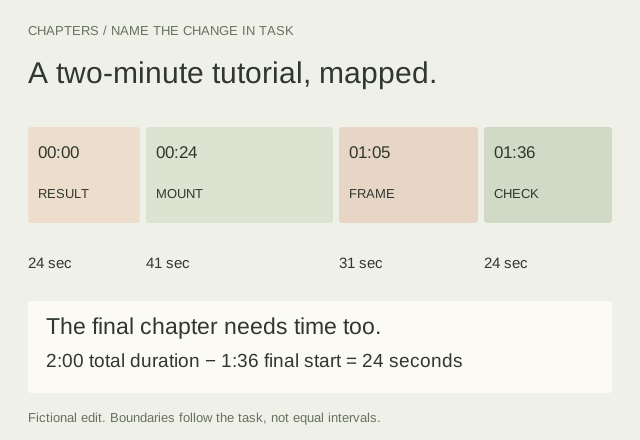
Plan Useful Chapters for a Finished Video
Map a two-minute edit, name the changes in task and check the final chapter as carefully as the first. Includes a blank chapter worksheet.
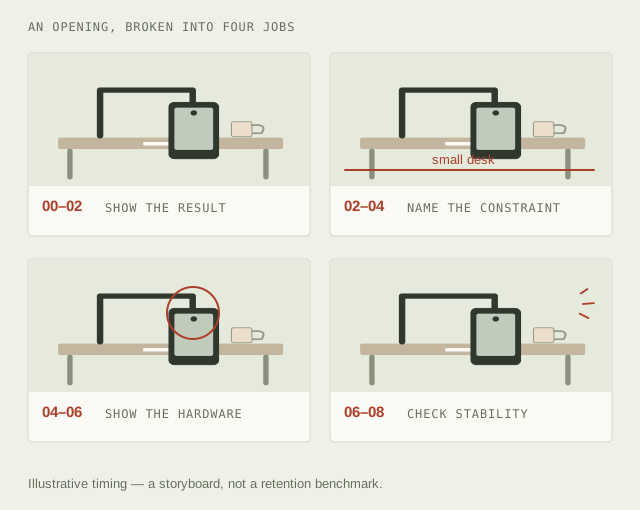
Build a Shot List Around What Each Image Needs to Do
Turn a viewer promise into a visual sequence. A fictional fourteen-second plan connects framing, audio, purpose and estimated runtime.
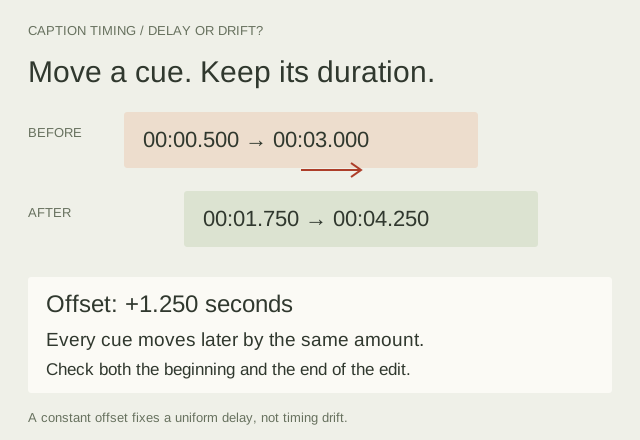
Fix Caption Timing Without Losing the Meaning
Read an SRT cue, distinguish a constant offset from drift, review overlaps and export a caption draft you can check against the final edit.